Joint statement demands accountability, federal infrastructure, and binding commitments to make human rights real for everyone in Canada.
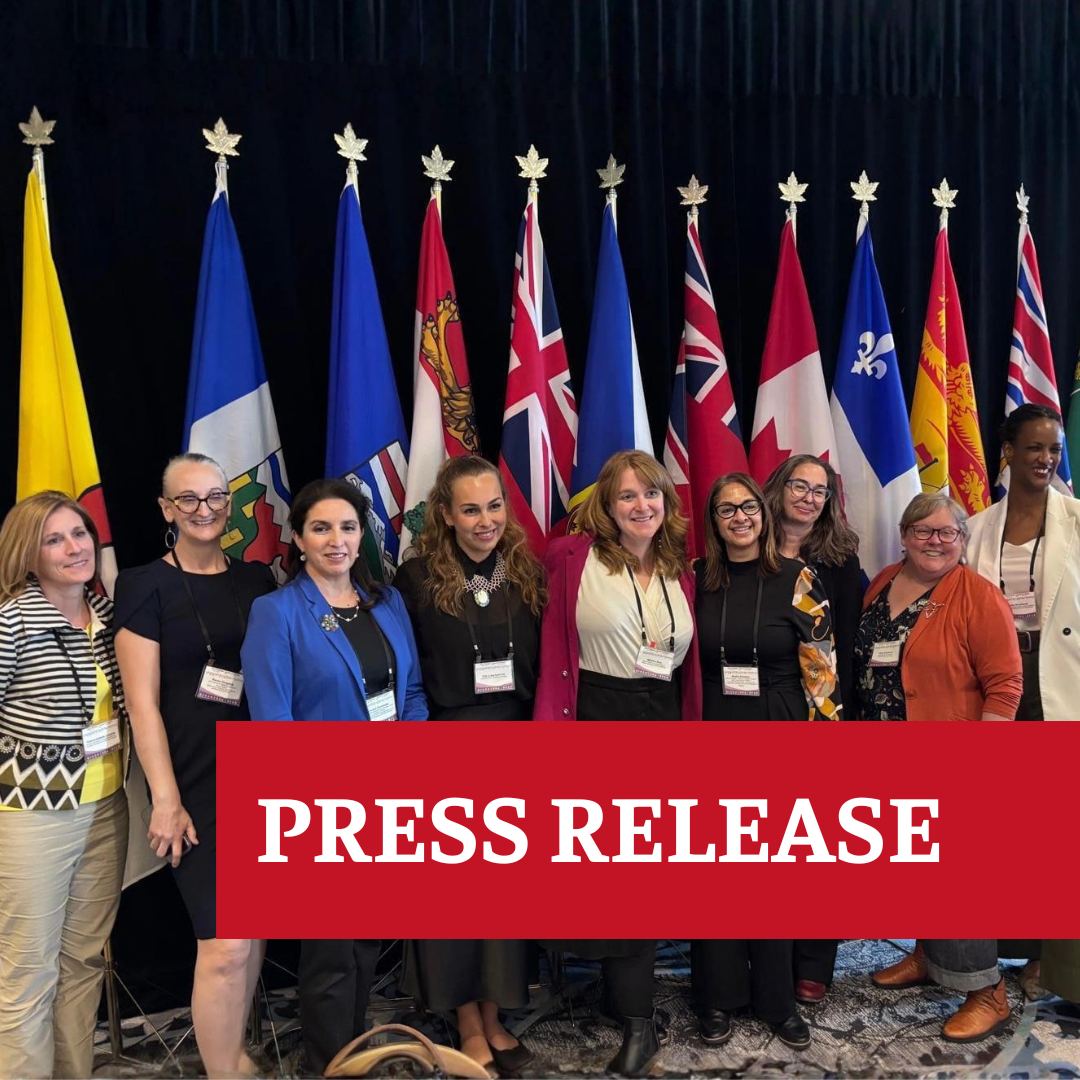
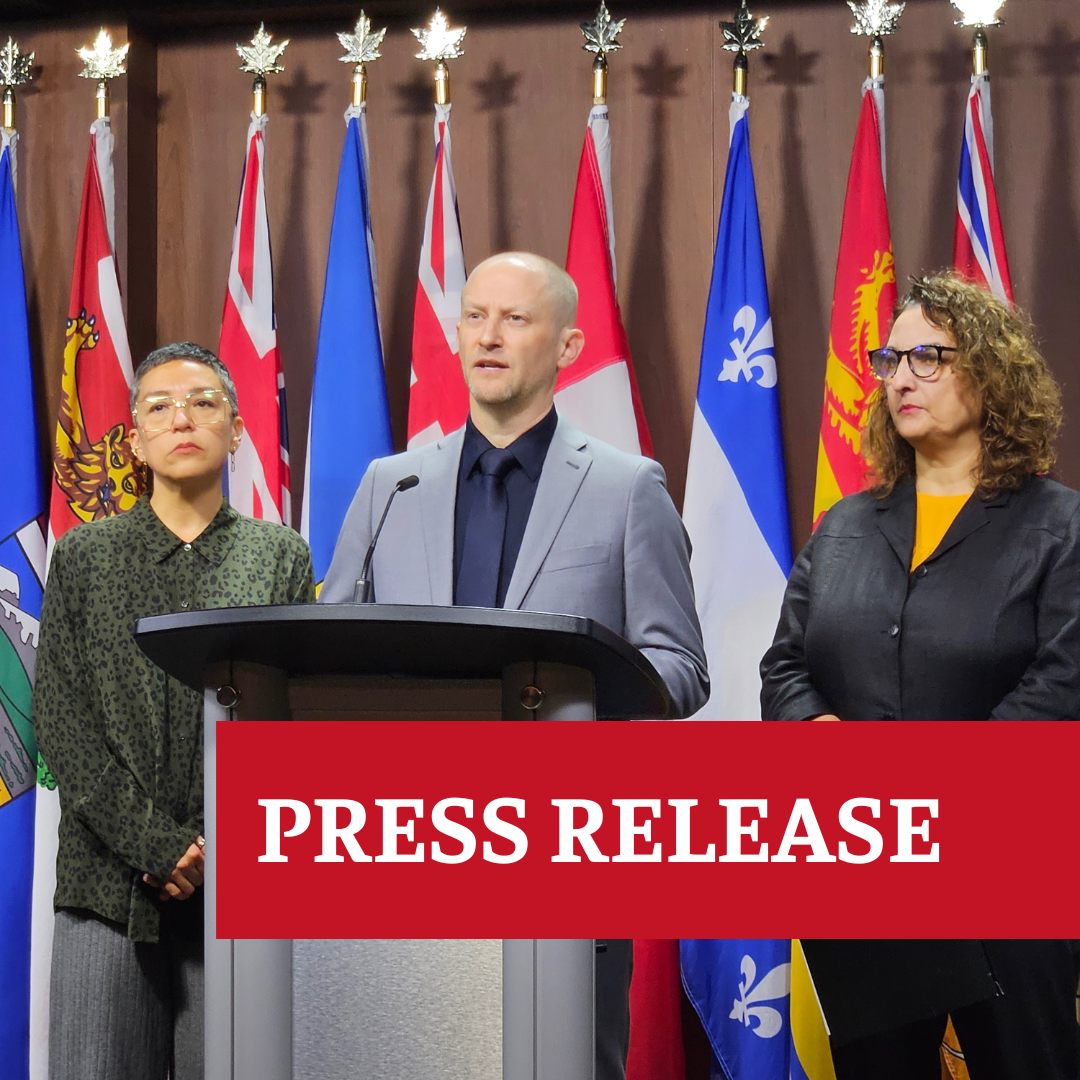
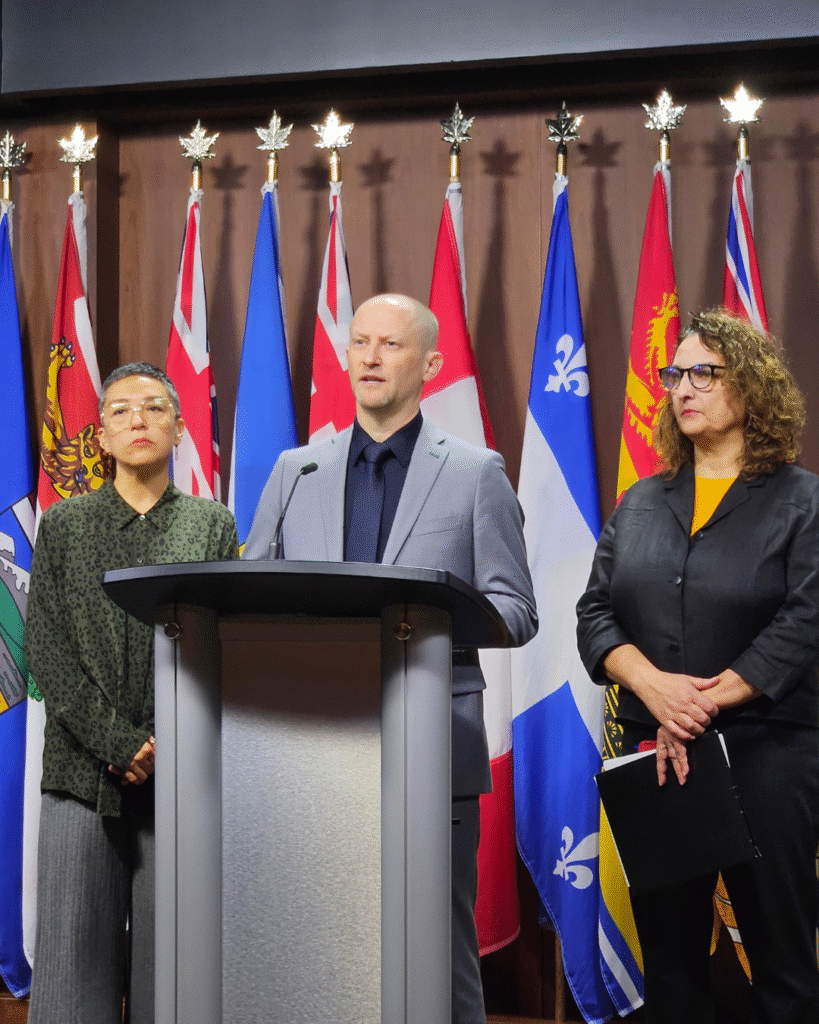
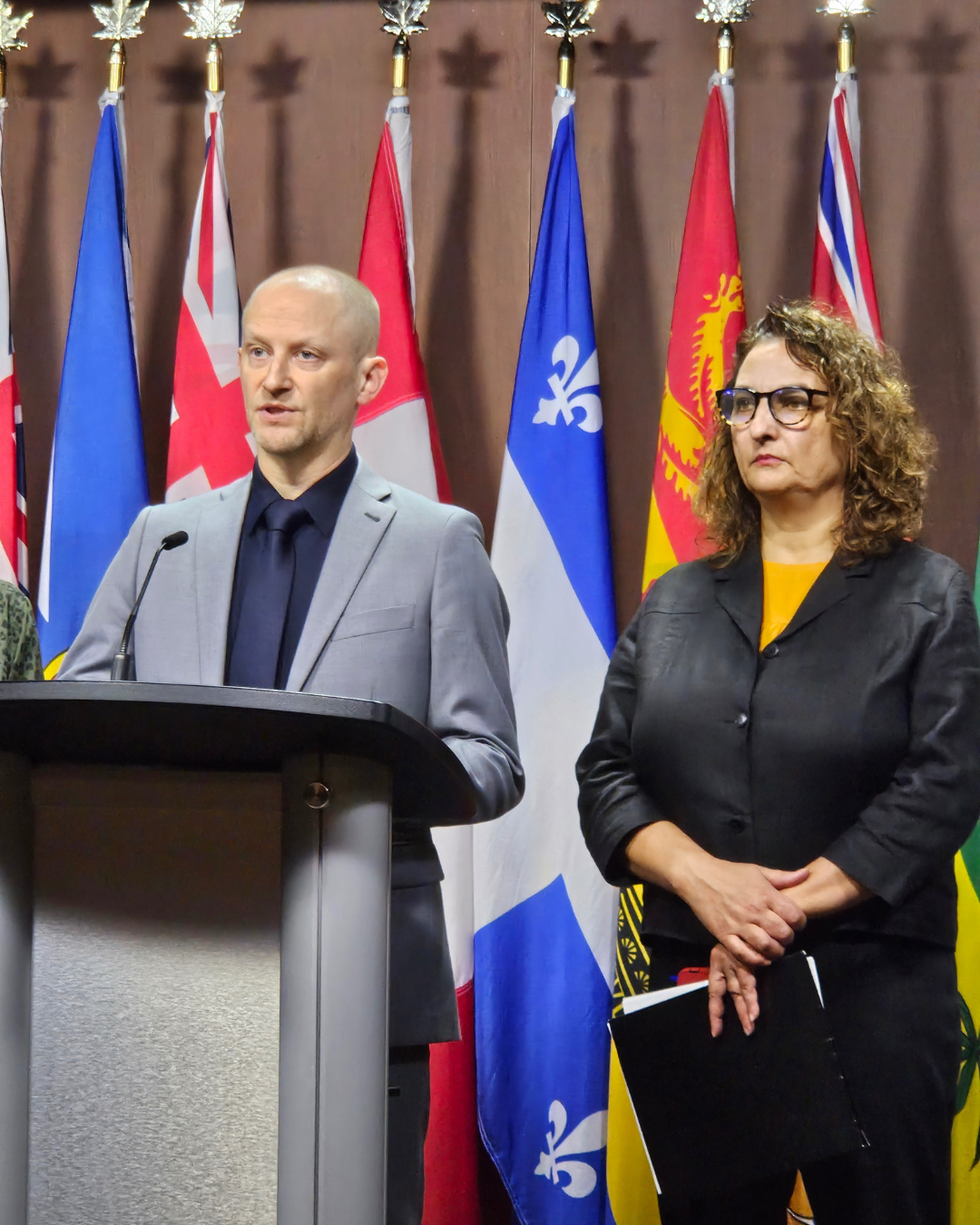
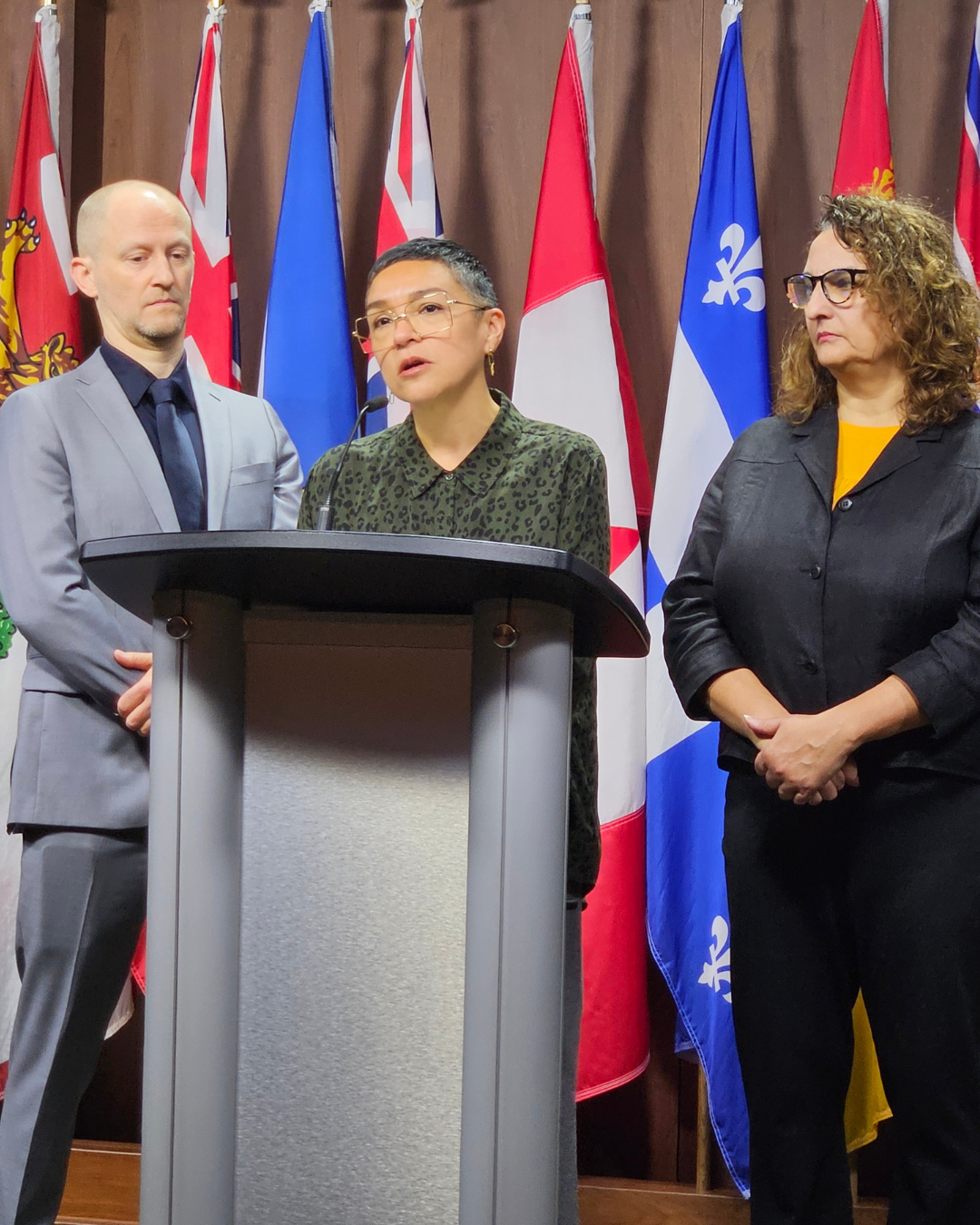
Regina (May 21, 2026) — As federal, provincial, and territorial representatives gather at the Forum of Ministers on Human Rights this week, the newly-formed Civil Society Forum for Human Rights in Canada is calling on governments to take immediate and concrete action on human rights implementation.
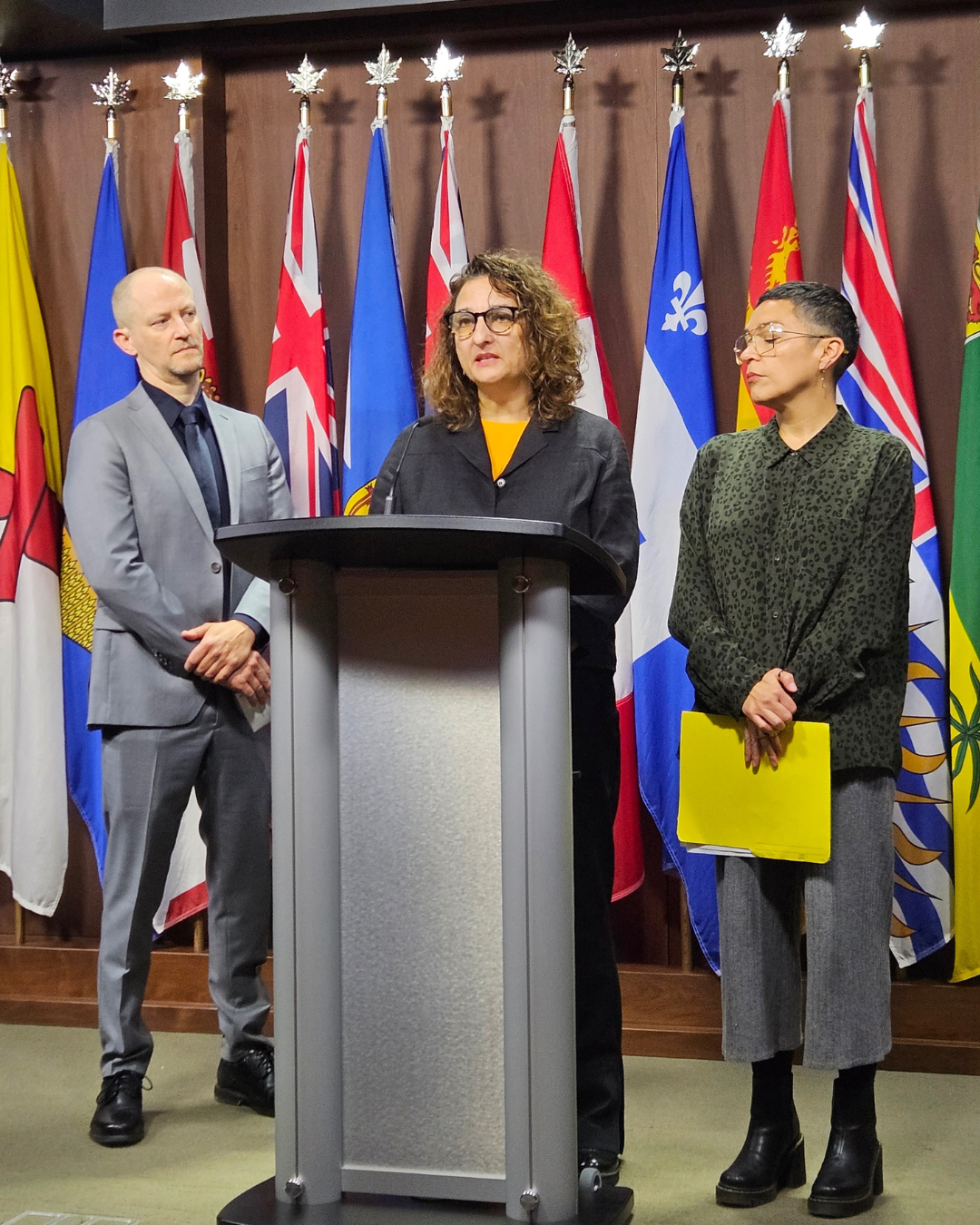
The Civil Society Forum delivered their statement to the Honourable Minister Marc Miller, responsible for human rights implementation at the federal level, the Honourable Minister Rebecca Alty, and the Honourable Rob Oliphant, along with Attorneys Generals from several provinces and territories — stressing the statement’s importance as a guidepost for human rights implementation at all levels of government.
“The timing of this Ministers’ Forum is critical. People across Canada are facing violence, discrimination, homelessness, environmental harm, and persistent inequality,” says Zoë Craig-Sparrow, Vice-President of Justice for Girls. “Canada participates in international review processes and receives recommendations, but domestically there is no implementation framework and no clear accountability mechanism. For Indigenous, racialized, migrant, low-income, women and gender-diverse persons, and disabled communities, these failures have life-and-death consequences.”
“Human rights cannot remain as simply words on paper. We need to close the gap between promises and action,” says Michèle Biss, Executive Director at the National Right to Housing Network. “When human rights go unimplemented, it shapes everything — people are excluded from decisions that affect them, and governments use narrow interpretations of their obligations in court to avoid accountability under the Charter. Governments at every level must step up to protect and save lives.”
Six Demands for Immediate Action
The Civil Society Forum is calling on governments to act on six priorities:
Transparent and accountable Ministers’ Forum — Establish a public mandate, clear decision-making processes, and a follow-up mechanism to track implementation commitments.
A legislated national human rights implementation framework — Develop a legal framework, with civil society input, to translate Canada’s domestic and international human rights obligations into lived reality no later than December 2027.
A federal Department of Human Rights — Create a dedicated central body, working in coordination with the Departments of Intergovernmental Affairs and Justice, to champion human rights implementation and ensure cohesion across all levels of government.
Economic, social, and cultural rights as binding legal obligations — Affirm these rights are justiciable and align legislation, budgeting, and policy accordingly — including ratification of the American Convention on Human Rights and the Optional Protocol of the International Covenant on Economic, Social and Cultural Rights, ahead of Canada’s UN review in early 2027.
A formal role for municipalities — Formalize local governments’ participation in human rights forums and implementation processes, given their frontline role in delivering programs that engage these rights.
Stable, ongoing funding for civil society engagement — Establish a civil society engagement fund, with contributions from each Forum member, to support treaty reporting, monitoring, and implementation work.
“As governments around the world openly challenge human rights, Canada has both the opportunity and the responsibility to demonstrate a different and more productive path forward, both in its interactions with other nations and through meaningful implementation at home,” says DJ Larkin, Executive Director of the Canadian Drug Policy Coalition.
“We are united in our shared belief that all human rights are indivisible, interdependent, and interrelated,” says Meghan Doherty, Director of Global Policy and Advocacy at Action Canada for Sexual Health and Rights. “And that systemic changes to Canada’s human rights infrastructure are necessary for the realization of any and all of our human rights.”
-30-
Media Contact: Jessica Tan Communications Lead National Right to Housing Network Jessica@housingrights.ca 613-621-4575
About the Civil Society Forum for Human Rights in Canada
The Civil Society Forum for Human Rights in Canada is a group of civil society organizations, advocates, and academics united around a shared vision: a Canada where human rights are not merely aspirational, but legally binding, fully funded, and felt in the daily lives of every person in this country.
Signatories
Action Canada for Sexual Health and Rights
Alex Neve, Professor of International Human Rights Law, University of Ottawa
Amnesty International Canadian Section (English-speaking)
Atlantic Human Rights Centre, St Thomas University
Canadian Centre for Housing Rights
Canadian Coalition for the Rights of Children
Canadian Drug Policy Coalition/Coalition canadienne des politiques sur les drogues
Canadian Feminist Alliance for International Action
Charter Committee on Poverty Issues
Colour of Poverty – Colour of Change
Human Rights Research and Education Centre, University of Ottawa
John Humphrey Centre for Peace and Human Rights
Justice for Girls
Maytree
Mining Watch Canada
National Right to Housing Network
Righting Relations Canada
Sandra Wisner, Director, International Human Rights Program, The Henry N.R. Jackman
Faculty of Law, University of Toronto
Social Rights Advocacy Centre
South Asian Legal Clinic of Ontario
The Canadian Association of Elizabeth Fry Societies
The Helix Foundation for Children and Youth
Backgrounder:
Despite being a signatory to numerous international human rights treaties, Canada has no formal infrastructure to implement recommendations from United Nations human rights bodies. This means that when the UN identifies gaps in Canada’s human rights record — on housing, health care, Indigenous rights, and more — there is no legal obligation, dedicated institution, or funded mechanism to act on them. The result is a persistent gap between the rights Canada promises and the reality people experience.
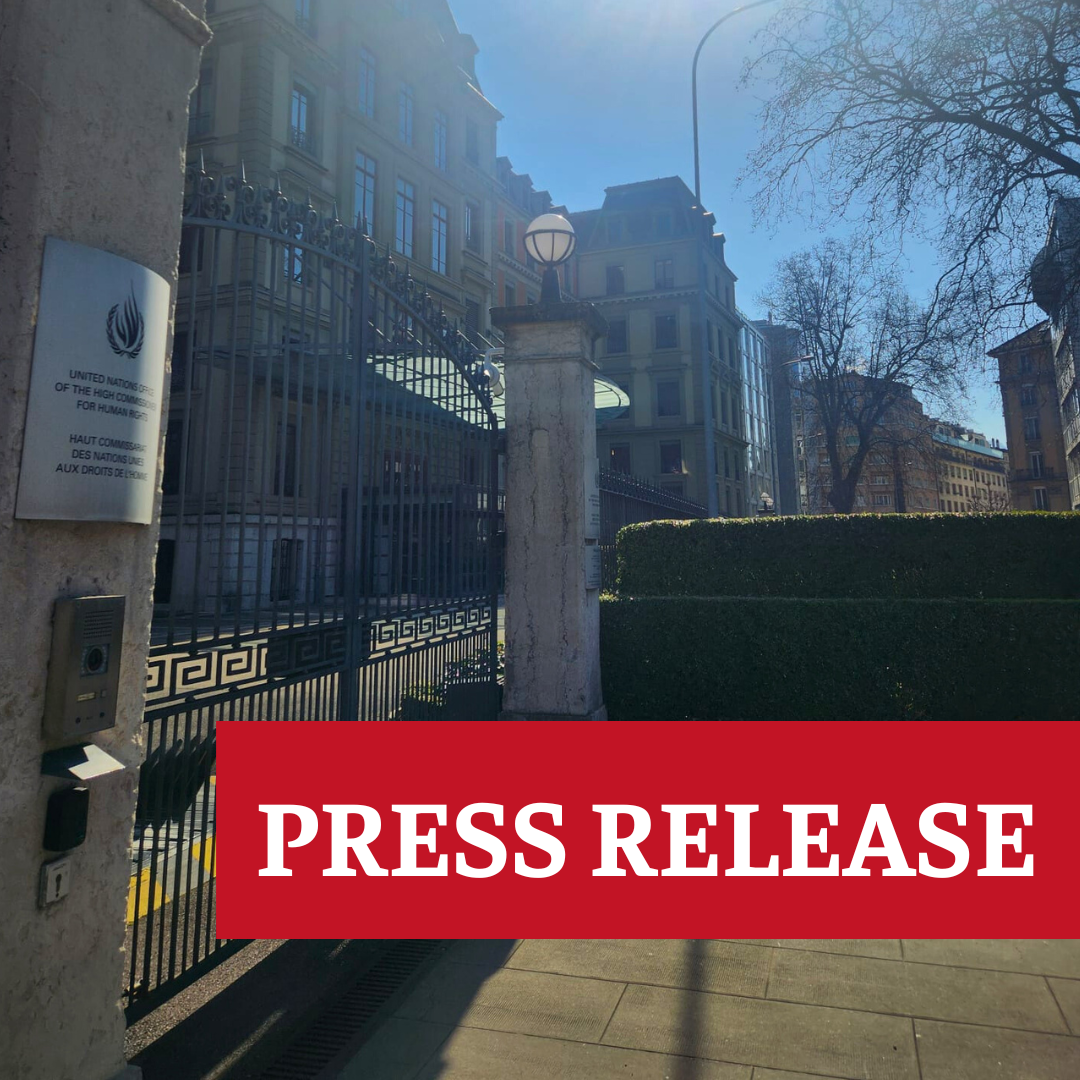
Ottawa, Canada | March 24, 2026—Yesterday, the United Nations Human Rights Committee released a report rebuking Canada’s narrow interpretation of the “right to life” and called for action to save and protect lives.
Human rights groups, including the National Right to Housing Network (NRHN), the Canadian Drug Policy Coalition (CDPC), the Canadian Feminist Alliance for International Action (FAFIA), and HIV Legal Network welcomed the report, which follows the Committee’s review of Canada’s implementation of the International Covenant on Civil and Political Rights (ICCPR) earlier this month.
“This is a significant and necessary correction,” says Michèle Biss, Executive Director of the National Right to Housing Network. “Canada has treated international human rights obligations as largely symbolic. The Committee has now made it clear: as a party to international human rights treaties like the International Covenant on Civil and Political Rights, Canada has made binding commitments that require real action—especially in the face of preventable deaths.”
The UN Committee expressed surprise during the review when Canada’s delegation stated that Canada does not accept the Committee’s authoritative findings that the right to life imposes “positive obligations” on governments to ensure access to essential health care, address homelessness, the drug toxicity crisis, or climate change.
Canada has not changed its position despite the Committee consistently affirming that protecting the right to life requires states to adopt “positive measures” and to address “general conditions in society” that threaten life. “Positive measures” require states to take proactive steps to guarantee rights, rather than merely refrain from violating them. This means tackling the root causes of preventable deaths, including homelessness, poverty, and the drug toxicity crisis. Notably, Canada had previously earned an “E” grade for rejecting a Committee decision affirming these principles in Toussaint v Canada.
In their report, the United Nations Human Rights Committee highlighted:
Rising drug toxicity deaths: The Committee expressed particular concern about “the very high number of deaths related to drug toxicity,” which “affects persons experiencing homelessness and poverty and disproportionately affect Indigenous persons.” Drug policies must be primarily based on “public health, harm reduction and human rights considerations.” This acknowledgment reinforces the need for a coordinated, rights-based response to overlapping crises and effective access to services, including harm reduction services. This is of particular importance at a time where both Ontario and Alberta have just announced the closure of many supervised consumption services by mid-June.
Lack of implementation mechanisms: Critically, Canada currently has no effective domestic mechanism to receive, coordinate, and implement recommendations from international human rights bodies. Without such a mechanism, Canada is failing to meaningfully act on guidance from the international community—including recommendations that could help address homelessness and unregulated drug toxicity to prevent further loss of life.
Gaps in the legal system: Canada is not doing enough to ensure that its international human rights obligations are understood and applied within its own legal system. The Committee called on Canada to strengthen awareness of the ICCPR among judges, prosecutors, and lawyers so that these obligations are meaningfully considered in domestic court decisions—an issue with profound implications for cases involving housing, homelessness, access to essential health and social services, and encampments.
Encampment evictions and rights violations: The Committee expressed concern about the use of extraordinary legal measures, including the notwithstanding clause, an issue that has tremendous impact on people marginalized by policy. For example, provincial governments threaten encampment residents with eviction despite positive court decisions without providing access to safe and adequate housing alternatives.
“We strongly support the Committee’s call for Canada to take ‘all necessary steps’ to address these concerns through effective mechanisms across federal, provincial, and territorial governments, and to ensure access to remedies through domestic courts,” says Beeta Senedjani from the Canadian Drug Policy Coalition, speaking on behalf of a coalition of human rights groups. “We also endorse the call for Canada to establish a national mechanism to monitor implementation and to ensure that individuals can seek enforcement of the Committee’s decisions.”
These recommendations build on the Committee’s longstanding position that the right to life requires governments to take positive measures to provide access without delay to shelter, social housing programs, and health care—a principle reaffirmed in its General Comment No. 36 and reinforced in the current review.
“We call on the federal government to respond urgently and meaningfully to the Committee’s findings,” says Biss. “We specifically await a response from Canadian Heritage Minister Marc Miller, Housing Minister Gregor Robertson, and Health Minister Marjorie Michel outlining how Canada will fulfill its obligations to international human rights law and the right to life.”
“The message from the Committee is clear,” says Senedjani. “Canada cannot continue to deny its responsibilities while people are dying preventable deaths. The right to life must include the right to live with dignity—and that starts with ensuring access to adequate housing and lifesaving health services.”
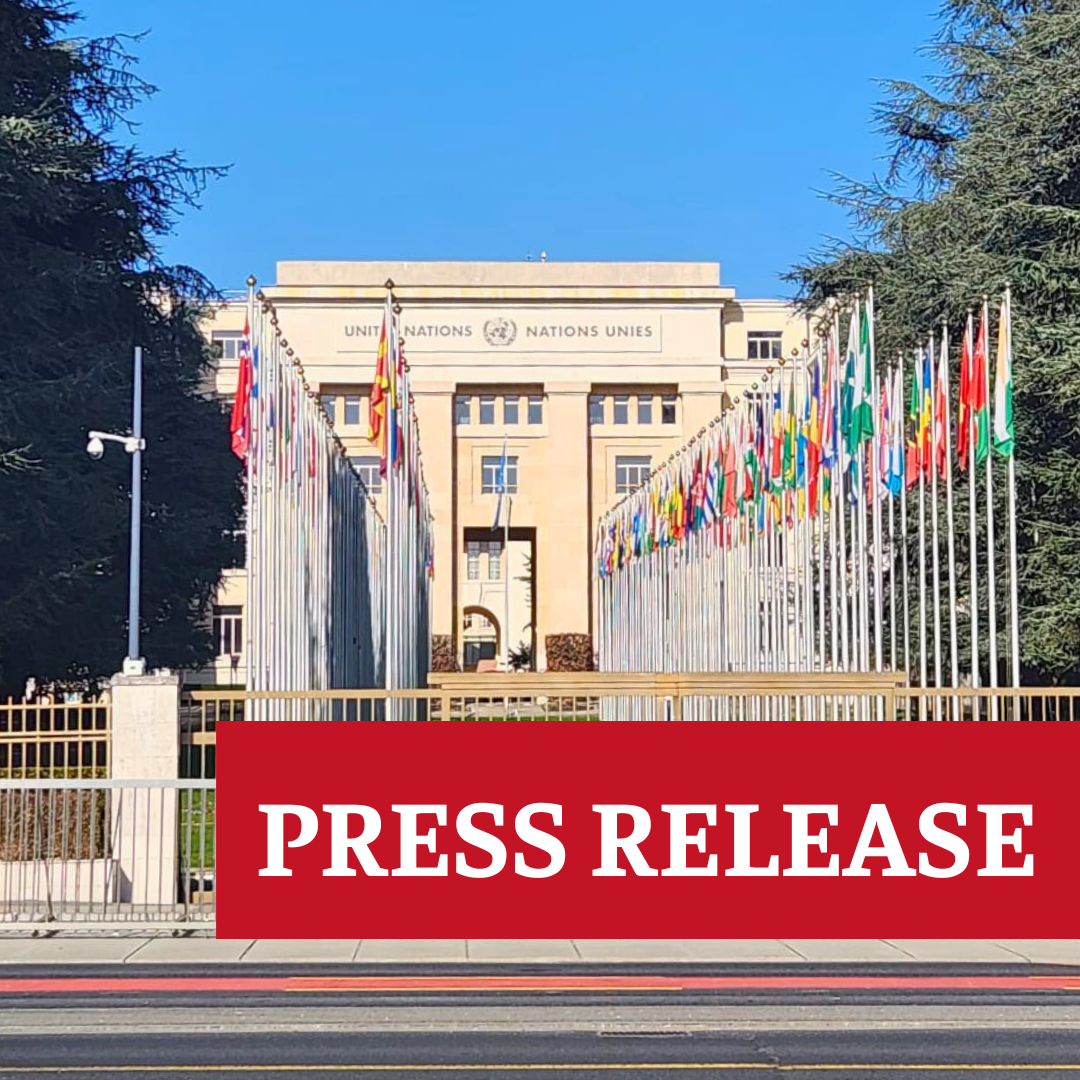
March 4, 2026 | Geneva — Today in Geneva, United Nations Human Rights Committee members expressed surprise at Canada’s claim that Article 6 of the International Covenant on Civil and Political Rights (ICCPR) does not require governments to take positive measures to protect life when it is at risk.
In a joint statement ahead of the Committee’s review of Canada’s ICCPR compliance, human rights groups had called on the Committee to press Canada to accept that the right to life requires governments to take positive measures to address systemic conditions that place lives at risk. These conditions include homelessness, lack of access to essential healthcare, toxic drug deaths, violence against Indigenous women and girls, food insecurity, unsafe water, inadequate disability supports, and climate change.
“In case after case, Canadian governments argue that even when people are dying, they have no constitutional duty to act,” says Michèle Biss, Executive Director of the National Right to Housing Network. “The right to life means more than simply refraining from harm. It requires governments to prevent foreseeable loss of life.”
The United Nations Human Rights Committee monitors Canada’s compliance with the ICCPR, which guarantees the “inherent right to life” in Article 6. This is the first time the committee has reviewed Canada since 2015. The Committee has consistently affirmed that protecting the right to life requires states to adopt “positive measures” and to address “general conditions in society” that threaten life. “Positive measures” require states to take proactive steps to guarantee rights, rather than merely refrain from violating them.
Today, committee members questioned Canada’s restrictive interpretation of the right to life, which includes denying any obligation to ensure access to health care when life is at risk. Committee members further raised concerns about Canada’s reliance on punitive responses to drug use and homelessness rather than addressing serious risks to life. Committee members referred to the Committee’s General Comment No. 36 (2018), which affirms that protecting the right to life requires states to adopt “positive measures” and to address “general conditions in society” that may threaten life, including inadequate health care, homelessness, toxic drug deaths and environmental degradation. Canada has rejected this interpretation in its submissions to the Committee and in litigation before domestic courts.
Domestically, Canada has opposed arguments invoking positive rights made under section 7 of the Canadian Charter of Rights and Freedoms, asserting that governments are not legally required to take positive measures—even where evidence shows that lives are in foreseeable danger. Canada has made these arguments in cases where individuals have invoked their right to life in response to homelessness, denial of health care, climate inaction, or the closure of supervised consumption sites.
“Canada’s refusal to fully uphold the right to life has allowed for thousands of preventable deaths across the country,” says Beeta Senedjani of the Canadian Drug Policy Coalition. “We are hopeful the committee will hold Canada to account and spur the changes we need to ensure all people in Canada can be healthy and safe.”
The coalition calls on the Committee to recommend that Canada:
Affirm that the right to life requires positive measures to protect life, consistent with the Committee’s jurisprudence;
Review and revise its domestic litigation positions to ensure consistency with its international human rights obligations;
Implement the Committee’s Views in Toussaint v. Canada; and
Ensure access to effective remedies for systemic violations of the right to life.
“Courts in Canada have held that international human rights laws are not abstract, aspirational principles,” says Sandra Ka Hon Chu, Co-Executive Director for the HIV Legal Network. “The Charter is presumed to provide protections as outlined in the international human rights treaties it has ratified.”
Canada’s Position on Positive Obligations Under Article 6 (Right to Life) NGO Joint Statement – Summary of Key Issues
The Legal Issue
Article 6 of the ICCPR protects the inherent right to life. The United Nations Human Rights Committee has clarified — beginning with General Comment No. 6 (1982) and reaffirmed in General Comment No. 36 (2018) — that this right requires positive measures to address systemic conditions that pose foreseeable threats to life.
These include environmental degradation, homelessness, hunger, substance use, and the denial of essential deprivation of essential health care and public services.
In Toussaint v Canada (2018), the Committee applied this interpretation to Canada, finding that denying essential health care to an irregular migrant exposed her to a reasonably foreseeable risk to life, in violation of Article 6. The Committee directed Canada to prevent similar violations in the future by ensuring access to essential health care where life is at risk.
Canada’s Position
Canada has:
Rejected the Committee’s interpretation that Article 6 requires positive measures addressing socio-economic conditions;
Stated it does not accept that the right to life includes a right to live with dignity where this might entail socio-economic obligations;
Declined to implement the Views in Toussaint because it does not agree with the Committees findings
Advanced arguments in domestic litigation, asserting that the right to life in section 7 of the Charter does not impose positive obligations to provide life-saving benefits or address systemic threats to life.
This position, when upheld by courts, has meant that individuals whose right to life under international law have been violated have no effective remedies under the Canadian Charter. Canada has an obligation to ensure access to effective remedies, requiring that the Charter of Rights be interpreted consistently with Canada’s obligations under international human rights law.
Systemic Impacts
The consequences of rejecting positive obligations under the right to life are evident across multiple areas:
Homelessness Deaths among people experiencing homelessness are rising, with significantly reduced life expectancy.
Essential Health Care Irregular migrants lack access to essential health care necessary to protect their lives. Lack of access to mental health services remains a systemic problem, with suicide a leading cause of death among youth. Indigenous peoples experience markedly reduced life expectancy and unmet health needs.
Substance Use Canada’s criminal laws make the unregulated drug supply more unpredictable, contaminated and potent, driving thousands of foreseeable, preventable deaths annually. Meanwhile, governments continue to argue that they have no obligation to provide, fund, or ensure the availability of proven lifesaving services to protect the right to life, including supervised consumption or safe supply.
Missing and Murdered Indigenous Women and Girls Indigenous women and girls face disproportionate rates of homicide. Most Calls for Justice from the National Inquiry remain unimplemented.
Disability Supports Inadequate social supports leave some persons with disabilities seeking Medical Assistance in Dying due to poverty and deprivation rather than irremediable suffering.
Water and Sanitation Dozens of long-term drinking water advisories remain in First Nations communities.
Food Insecurity Approximately one in four people in Canada live in food-insecure households, a condition linked to premature mortality.
Climate Change Canada is not on track to meet its Paris Agreement targets and is particularly vulnerable to the effects of climate change. Extreme heat and wildfires have already resulted in documented loss of life and serious health impacts.
What the Coalition Is Requesting
The coalition calls on the Committee to recommend that Canada:
Publicly affirm that the right to life in Article 6 requires positive measures to address systemic threats to life;
Align its domestic litigation positions with its international human rights obligations;
Implement the Committee’s views in cases involving the right to life that have been denied effective remedies
Blocked From Testifying, Civil Society Groups Urge Withdrawal of Bill C-12 Citing Threats to Human Rights and to Fundamental Justice
OTTAWA, Nov. 24, 2025 –A broad coalition of groups from across Canada is sounding an urgent alarm in advance of a critical parliamentary vote on Bill C-12.
The bill would open the door to discrimination and violations of human rights and due process in Canada’s immigration system, authorize sharing of sensitive personal immigration information, and expand dangerous approaches to drug policy. Yet it is being pushed through parliament with minimal debate while those that will be impacted by its sweeping changes are locked out of the process.
“This deeply concerning and highly controversial legislation will put many refugees in danger, risking their return to persecution in violation of rights protected under the Charter and international law,” said Gauri Sreenivasan, Co-Executive Director of the Canadian Council of Refugees. “And yet the bill is moving at break neck speed through Parliament while those with expertise and lived experience who want to advise on its dangers are shut out of the process. Neither the law nor the public interest is being served.”
The bill will deny many refugees access to fair and independent assessment and full appeal of their claims by the Immigration and Refugee Board because of arbitrary time limits and exclusions. This approach will not streamline Canada’s processing of refugee claims, but will lead to lower quality decisions while shifting backlogs to our already overburdened Federal Courts and to IRCC.
The bill will also compound harm arising from the Canada-US Safe Third Country Agreement, which abandons many refugees to the U.S. immigration system at a time when well documented human rights violations have become the dominant feature of that system.
”Bill C-12 would deny protection to vulnerable people irrespective of changes to their personal circumstances or political conditions back home. So many people like me, who sought safety here and have made lives here, would be shut out by this Bill. This isn’t just policy, it’s people’s lives,” said Tonny Muzira, Co-Founder & Director of Advocacy and Partnerships Centre for Black Development Options Canada. “Canada cannot turn its back on those seeking safety.”
Under Bill C-12, the government will also be able to cancel or suspend immigration documents and applications based on an undefined assessment of the “public interest”. This power grants dangerous discretionary power to the government without any individualized assessment or procedural safeguards.
“The bill sets up open-ended powers with little thought to the consequences and inevitable abuse”, said Louis-Philippe Jannard, of the Table de concertation des organismes au service des personnes réfugiées et immigrantes (TCRI). “We haven’t seen such broad, discretionary powers in our immigration system since the 1970’s, when their abuse led to rampant discrimination and fatal decisions.”
Bill C-12 would also authorize the government to share highly sensitive immigration information with few limitations. This includes changes in gender identity and the status of any refugee claimants, exposing vulnerable people in Canada to severe risk.
“Broad dissemination of sensitive personal information can place migrants and refugees at significant risk of discrimination and persecution in Canada and abroad”, said Tamir Israel, Director of the Canadian Civil Liberties Association’s Privacy, Surveillance and Technology Program. “Despite this significant potential for abuse, Bill C-12 lacks minimum safeguards like the need to ensure information sharing is necessary and proportionate.”
Bill C-12 also doubles down on prohibition-based drug policy that has demonstrably failed to protect public health and safety.
“Instead of funding affordable housing and other health and social supports, Canada is supporting U.S.-led militarized drug enforcement,” said Nick Boyce, from the Canadian Drug Policy Coalition. “If Canada follows this path, it will be complicit in violations of international human rights law.”
In disregard of the dire risks posed by this legislative proposal, the bill has been fast-tracked and received minimal consideration in Parliament. It is scheduled for a final vote by the Standing Committee on Public Safety tomorrow—just three weeks after its study of the bill began.
Despite the highly attenuated timeline, dozens of refugee and migrant groups, human rights groups, labour organizations, health advocacy groups, representatives of the Black community, gender based violence groups, legal professional bodies, drug policy groups and others requested to speak at committee hearings but were denied. They have also submitted briefs expressing concern regarding Bill C-12’s consequences.
These groups were largely absent from committee proceedings and MPs will not have the time to consider the long list of concerns raised by these submissions. In contrast, MPs heard repeatedly from border and policing agencies and officials. The end result is that the voices of those most impacted by Bill C-12 have not been heard.
“MPs and the public should be extremely concerned that the government is fast-tracking legislation that will only multiply the possibility of discrimination, exploitation, and violations of human rights,” said Karen Cocq of the Migrant Rights Network. “ This government got elected promising to reject Trump-style politics, but Bill C-12 is the opposite of that. This bill cannot be fixed, it must be withdrawn.”
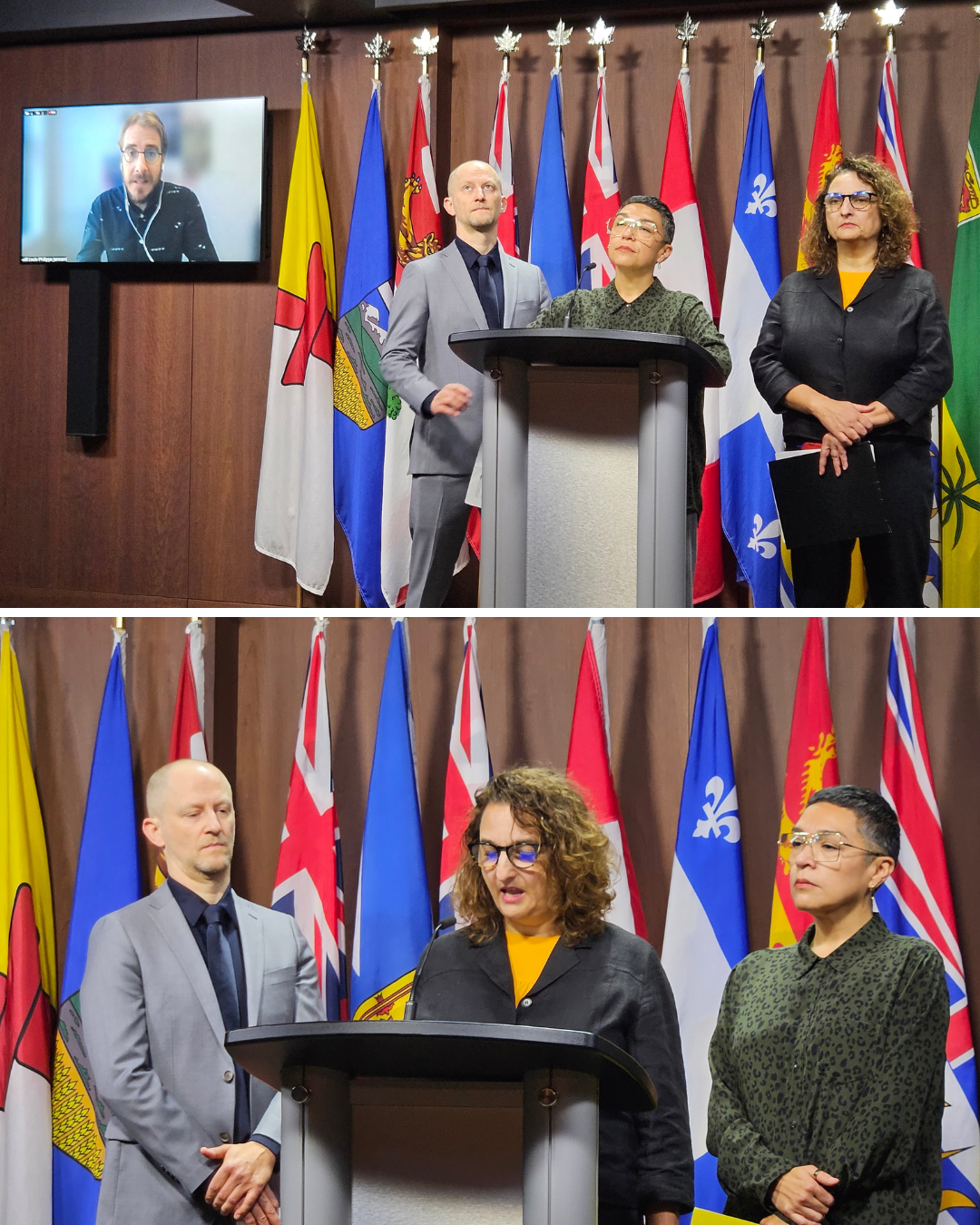
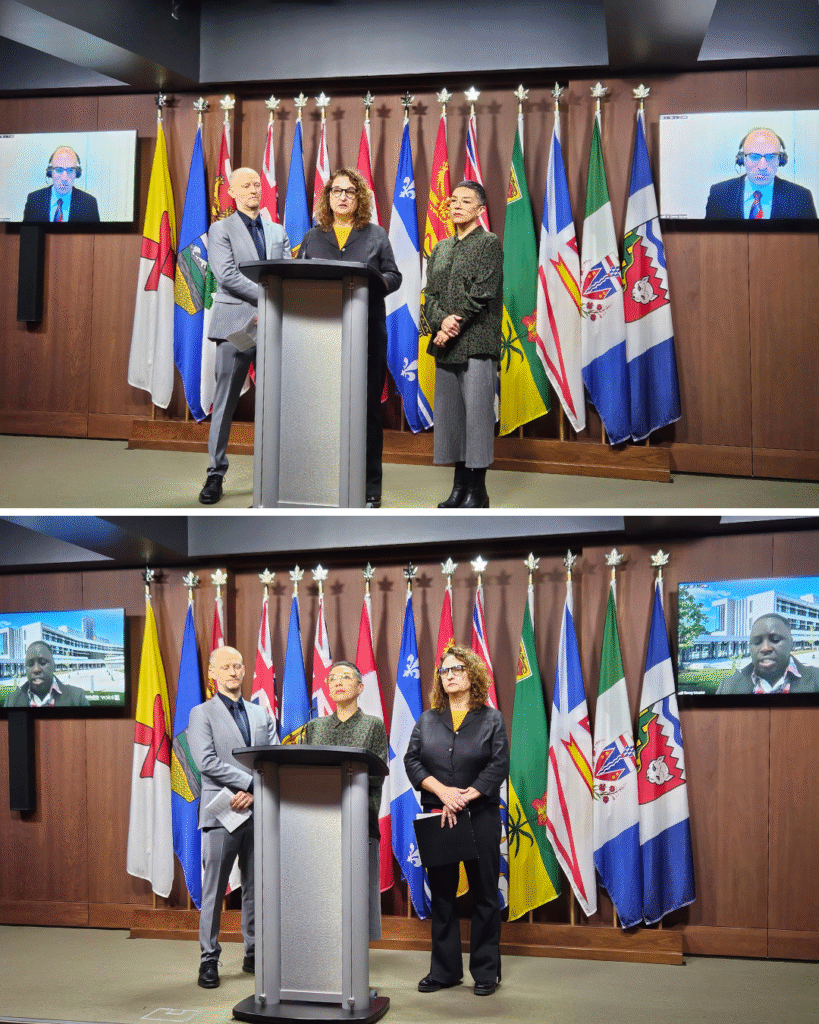
Images from the Ottawa, ON press conference featuring in-person speakers Nick Boyce, Gauri Sreenivasan and Karen Cocq, and Zoom speakers Louis-Philippe Jannard, Tonny Muzira and Tamir Israel.
POUR DIFFUSION IMMÉDIATE
Des organisations de défense des droits sonnent l’alarme à la veille d’un vote crucial sur le projet de loi C-12
Empêchés de témoigner, des groupes de la société civile demandent le retrait du projet de loi C-12 en invoquant des menaces aux droits humains et aux principes de justice fondamentale.
OTTAWA, 24 novembre 2025 – Une large coalition pancanadienne d’organisations sonne l’alarme à la veille d’un vote crucial à la Chambre des communes sur le projet de loi C-12.
Le projet de loi ouvrirait la porte à la discrimination, aux atteintes aux droits humains et au non-respect de principes d’application régulière de la loi au sein du système canadien d’immigration, il autoriserait le partage d’informations personnelles sensibles en matière d’immigration et approfondirait des approches dangereuses relatives aux politiques sur les drogues. Le gouvernement accélère toutefois son étude au parlement, avec des débats limités, alors que les personnes et les groupes qui subiront les effets de ces changements majeurs ne sont pas entendus.
« Cette proposition législative profondément inquiétante et controversée plongera plusieurs personnes réfugiées dans des situations dangereuses, à risque de retour vers la persécution, en violation des droits protégés par la Charte canadienne et le droit international », affirme Gauri Sreenivasan, codirectrice générale du Conseil canadien pour les réfugiés. « Cependant, le projet de loi avance à vitesse grand V au Parlement, pendant que celles et ceux qui ont l’expertise et le vécu et qui veulent mettre en garde les parlementaires contre les dangers qu’il présente sont exclus du processus. Cela ne sert ni la loi ni l’intérêt public. »
Le projet de loi privera plusieurs personnes réfugiées d’un examen juste et indépendant de leur demande et des mécanismes d’appel de la Commission de l’immigration et du statut de réfugié (CISR) en raison de restrictions temporelles et d’exclusions arbitraires. Cette approche n’améliorera pas le processus d’examen des demandes d’asile, mais minera plutôt la qualité des décisions tout en déplaçant les arriérés de la CISR vers IRCC et vers la Cour fédérale, qui est déjà surchargée.
Ce projet de loi aggravera également les préjudices qui découlent de l’Entente canado-américaine sur les tiers pays sûrs, qui abandonne plusieurs personnes au système américain d’immigration, à un moment où des atteintes aux droits humains sont documentées et où elles sont devenues une caractéristique fondamentale de ce système.
« Le projet de loi C-12 refuserait la protection à des personnes vulnérables, peu importe les changements à leur situation personnelle ou à la situation politique dans leur pays d’origine. Il y a tellement de personnes qui, comme moi, sont venues ici chercher la sécurité et refaire leur vie, et qui seraient exclues par ce projet de loi. Il ne s’agit pas seulement de politiques publiques, mais de la vie de ces personnes, » déclare Tonny Muzira, cofondateur et directeur du plaidoyer et des partenariats du Centre for Black Development Options Canada.
Avec le projet de loi C-12, le gouvernement aura également le pouvoir d’annuler ou de suspendre des documents ou demandes d’immigration sur la base d’une évaluation non définie de « l’intérêt public ». Ce projet de loi octroie au gouvernement un pouvoir discrétionnaire dangereux, sans aucun examen individuel ou garanties procédurales.
« Le projet de loi met en place de vastes pouvoirs discrétionnaires, avec peu de réflexions quant à leurs conséquences et aux abus qui en découleront inévitablement, » soutient Louis-Philippe Jannard, de la Table de concertation des organismes au service des personnes réfugiées et immigrantes. « D’aussi larges pouvoirs discrétionnaires n’existent plus dans notre système d’immigration depuis les années 1970, pouvoirs qui laissaient alors place à des décisions largement discriminatoires et aux conséquences parfois funestes. »
Le projet de loi C-12 autorisera le gouvernement à partager des informations très sensibles contenues dans les dossiers d’immigration, et ce, avec très peu de balises. Cela comprend des changements à l’identité de genre ou le statut de toute personne en demande d’asile, mettant à risque des personnes vulnérables au Canada.
« La large diffusion d’informations personnelles sensibles peut mettre les personnes migrantes et réfugiés à risque de discrimination et de persécution au Canada et ailleurs, » martèle Tamir Israel, directeur du programme Vie privée, surveillance et technologies de l’Association canadienne des libertés civiles. « Malgré le grand potentiel d’abus, le projet de loi C-12 ne contient pas de garanties minimales comme l’exigence de s’assurer que le partage d’informations est nécessaire et proportionnel. »
Le projet de loi C-12 renforce aussi une politique relative aux drogues basée sur la prohibition qui n’a manifestement pas permis de protéger la santé et la sécurité publiques.
« Plutôt que de financer le logement abordable et d’autres mesures sociales et de santé, le Canada soutient la lutte antidrogue militarisée menée par les États-Unis », affirme Nick Boyce, de la Coalition canadienne des politiques sur les drogues. « Si le Canada poursuit dans cette voie, il pourrait se retrouver complice de violations du droit international des droits humains. »
Sans tenir compte des risques considérables qu’il pose, le projet de loi a suivi un processus accéléré et n’a fait l’objet que d’un examen minimal au Parlement. Le vote final du Comité permanent de la Sécurité publique et nationale est prévu demain – seulement trois semaines après que l’étude du projet de loi ait débuté.
Malgré de très courtes échéances, des douzaines d’organismes au service des personnes réfugiées et immigrantes, d’organisations de défense des droits humains, d’organisations syndicales, de groupes du milieu de la santé, de représentant-e-s de la communauté noire, de groupes de lutte contre la violence basée sur le genre, d’instances de professionnel-le-s du droit, de groupes sur les politiques en matière de drogues et autres ont demandé à être entendus lors des audiences tenues par les comités, mais cela leur a été refusé. Ils ont aussi déposé des mémoires exprimant leurs préoccupations quant aux conséquences du projet de loi C-12.
Ces groupes ont donc été largement absents des débats des comités et les député-e-s n’auront pas le temps de prendre en considération la longue liste d’inquiétudes soulevées dans leurs mémoires. À l’inverse, les député-e-s ont entendu de façon répétée des représentants d’agences frontalières et policières. Il en résulte que les voix des personnes qui souffriront le plus des effets du projet de loi C-12 n’ont pas été entendues.
« Les député-e-s et le public devraient s’inquiéter au plus haut point du fait que le gouvernement accélère l’étude d’une proposition législative qui ne fera que multiplier les possibilités de discrimination, d’exploitation et d’atteintes aux droits humains, » dénonce Karen Cocq, du Migrant Rights Network. « Ce gouvernement a été élu en promettant de rejeter les politiques d’inspiration trumpiste, mais le projet de loi C-12 est à l’opposé de ces promesses. Rien ne pourrait rendre ce projet de loi acceptable, il doit être retiré ».
– 30 –
Contacts médias :
Jessica Hannon, Direction des communications jthannon@sfu.ca
Blocked From Testifying, Civil Society Groups Demand Withdrawal of C-12 Citing Threats to Human Rights and Lack of Due Process and Oversight
WHAT: Press Conference – Coalition of Civil Society Organizations Calls for Withdrawal of Bill C-12
WHEN: Monday, November 24, 2025 at 10:00 AM EST
WHERE:
In Person: Room 135-B, West Block, Parliament Hill, Ottawa
Online: Contact pressres2@parl.gc.ca for Zoom link
WHO:
Gauri Sreenivasan, Co-Executive Director, Canadian Council for Refugees
Tamir Israel, Canadian Civil Liberties Association
Louis-Philippe Jannard, Table de concertation des organismes au service des personnes réfugiées et immigrantes (TCRI), Front Commun Contre le Projet de Loi C-12
Nick Boyce, Canadian Drug Policy Coalition
Tonny Muzira, Centre for Black Development Options Canada
Karen Cocq, Spokesperson, Migrant Rights Network
OTTAWA – A broad coalition of civil society organizations from across Canada will hold a press conference to denounce their exclusion from deliberations on Bill C-12 and demand its withdrawal. Bill C-12 is a sweeping law that would expand deportation powers, gut refugee protections, ramp up information-sharing with foreign governments, and doubles down on enforcement and militarized approaches to drug use. The Public Safety Committee is doing clause-by-clause review and voting on amendments on November 25, after which C-12 will go back to the House for third and final reading.
Despite applications from dozens of refugee, migrant, civil liberties, Black community, health, and drug policy organizations, only three groups were invited to testify. Meanwhile, MPs repeatedly heard from border and policing agencies — shutting out the very communities most impacted by Bill C-12.
While the government has kept separate some controversial surveillance and privacy provisions in their original Bill C-2, civil liberties, migrant and refugee rights, and drug policy organizations remain deeply concerned about the threat to human rights represented by Bill C-12. These include:
Allowing sharing of immigration information with foreign governments, including the U.S. and potentially authoritarian states from which migrants are fleeing persecution;
Abandoning of refugee obligations under the Charter and international law, denying refugee hearings to those who have been in Canada over a year and from the US —regardless of whether personal or home country circumstances have changed, including disproportionate harm to survivors of gender-based violence;
Granting the government broad discretionary powers to cancel, suspend and change immigration applications and increase deportations without adequate due process;
Further criminalization and militarization of Canada’s approach to drug use that is not founded in evidence or best practices.
Remarks will be delivered in English and French, interviews will be available in English and French.
For media inquiries, contact: Karen Cocq, Migrant Rights Network
AVIS AUX MÉDIAS
Des groupes de défense des droits lancent un avertissement urgent avant un vote final sur le projet de loi C-12
Des groupes de la société civile qui ont été empêchés de témoigner demandent le retrait du projet de loi C-12, en raison de menaces aux droits humains et de l’absence de procédure adéquate et de mécanismes de contrôle appropriés
QUOI: Conférence de presse – Une coalition d’organisations de la société civile demande le retrait du projet de loi C-12
QUAND: Lundi, 24 novembre 2025 à 10h
OÙ:
En personne: local 135-B, édifice de l’Ouest, Colline Parlementaire, Ottawa
Gauri Sreenivasan, codirectrice générale, Conseil canadien pour les réfugiés
Tamir Israel, Association canadienne des libertés civiles
Louis-Philippe Jannard, Table de concertation des organismes au service des personnes réfugiées et immigrantes, Front commun du Québec contre le projet de loi C-12
Nick Boyce, Coalition canadienne des politiques sur les drogues
Tonny Muzira, Centre for Black Development Options Canada
Karen Cocq, porte-parole, Migrant Rights Network
OTTAWA – Une large coalition pancanadienne d’organisations de la société civile tiendra une conférence de presse pour dénoncer leur exclusion des consultations relatives au projet de loi C-12 et pour demander son retrait. Le projet de loi C-12 ratisse large et élargirait les pouvoirs de renvoi, amoindrirait les protections pour les personnes réfugiées, faciliterait le partage d’informations avec des gouvernements étrangers et renforcerait une approche d’inspiration policière et militaire quant à l’utilisation de drogues. Le Comité sur la Sécurité publique et nationale procèdera à l’étude article par article et au vote sur les amendements le 25 novembre, après quoi le projet de loi C-12 sera renvoyé à la Chambre des communes pour la troisième et dernière lecture.
Malgré les demandes de douzaines d’organisations des milieux des personnes réfugiées et immigrantes, des droits et libertés, des communautés noires, de la santé et des politiques relatives aux drogues, seuls trois groupes ont été invités à témoigner. Pendant ce temps, les député-e-s ont entendu de façon répétée des agences policières et frontalières – excluant les communautés les plus affectées par le projet de loi C-12.
Alors que le gouvernement a laissé de côté certaines dispositions controversées relatives à la surveillance et à la vie privée dans le projet de loi C-2, des organisations de défense des droits et libertés, de défense des droits des personnes migrantes et réfugiées et des politiques relatives aux drogues s’inquiètent profondément des menaces aux droits humains contenues dans le projet de loi C-12:
Permettre le partage d’informations relatives à l’immigration avec des gouvernements étrangers, y compris les États-Unis et des États potentiellement autoritaires d’où les personnes migrantes fuient la persécution;
Abandonner les obligations envers les personnes réfugiées qui découlent de la Charte canadienne et du droit international, dont le refus d’accès à une audience de détermination du statut de réfugié aux personnes qui sont au Canada depuis plus d’un an ou qui arrivent des États-Unis, peu importe les changements aux conditions personnelles ou dans les pays d’origine, incluant des préjudices disproportionnés pour les personnes survivantes de violence basée sur le genre;
Donner au gouvernement de vastes pouvoirs discrétionnaires pour annuler, suspendre ou modifier des demandes d’immigration et pour accroître les déportations sans procédures adéquates;
Approfondir la criminalisation et la militarisation de l’approche canadienne relative à l’utilisation des drogues, ce qui n’est pas fondé sur la recherche ou les meilleures pratiques.
Les prises de paroles se feront en anglais et en français et des entrevues seront possibles en anglais et en français.
Pour les demandes médias, contactez Karen Cocq, Migrant Rights Network
Canada | October 24, 2025 – With reasoning that will have implications nationwide amid an ongoing public health crisis, the Supreme Court of Canada delivered a landmark judgement today, affirming that the Good Samaritan Drug Overdose Act must be interpreted to fulfill its life-saving purpose. In a majority decision, the Court recognized the importance of clarity and ruled that the Act must ensure that people who call 9-1-1 during an overdose will not face arrest for simple drug possession. Advocates argue this decision represents a critical victory for public health and evidence-based approaches to the unregulated drug crisis in Canada.
“We are relieved and happy,” says Corey Ranger, president of the Harm Reduction Nurses Association, one of three organizations who intervened together in the case. “As health care providers, we see the consequences when people delay calling 9-1-1—brain injuries, trauma, and deaths that could have been prevented. The Court has recognized these harms, and the importance of preventing them. The Court has also recognized that harm reduction saves lives, and that protecting public health must be prioritized over punishment.”
At issue in R v Wilson was application of the Good Samaritan law, which protects people who call 9-1-1 or remain at the scene of an overdose from criminal charges and convictions for simple drug possession. The purpose of the law is clear: prevent injuries, save lives, encourage people to not use alone and to call 9-1-1 in case of emergency.
The case centered on events in Saskatchewan in 2020: Paul Wilson and others called 9-1-1, performed CPR, and stayed on scene to save a woman’s life in a drug-related medical emergency. Despite their life-saving actions, police arrested Mr. Wilson, the woman herself and others at the scene for drug possession, then used those arrests as grounds to search them and charge them with trafficking and other offenses. The court was asked to consider: does the Criminal Code authorize the arrest of an individual at the scene of a “drug overdose” for the offence of simple drug possession, even if the individual may ultimately be immune from being charged or convicted for that offence?
The Canadian Drug Policy Coalition, Harm Reduction Nurses Association, and l’Association des intervenants en dépendance du Québec intervened as a coalition to offer the Supreme Court an analytical path grounded in public health principles and ask it to ensure this law fulfills its purpose: to prevent the devastating and avoidable consequences of drug-related medical emergencies. The coalition argued that to do so, it must prevent harm, be clear enough to be understood by the public, and ensure that any examination of its purpose is devoid of latent bias.
“We are heartened by this decision, and the court’s affirmation of the importance of following evidence and avoiding speculation,” says DJ Larkin, lawyer and executive director of the Canadian Drug Policy Coalition. “Importantly, this decision emphasized the need to focus on actual harms – possible injury or death, rather than remote or hypothetical assumptions that arrests increase public safety in these situations.”
[48] …In the narrow circumstances attracting the application of s. 4.1(2), where a life must necessarily be threatened by a medical emergency, Parliament prioritized saving that life over the more remote public safety benefits of arresting persons at the scene for simple possession…
“This distinction is key, and we commend the Court for its thoughtful assessment of what constitutes harm and safety. Courts are a place of thoughtful analysis and rigorous evidence. Judicial decisions need to interrogate assumptions made about people who use drugs and the impacts of drug law enforcement. The decision demonstrates grounding in the importance of evidence-based, public-health-first approaches to drug policy and public safety.”
“This represents an important victory for public health and community overdose response,” says Louis Letellier de St-Just, board president of l’Association des intervenants en dépendance du Québec. “We know that to effectively prevent deaths and devastating injuries from overdose, the law must remove the fear of arrest that stops people from calling for help. It must be clear and easily understood. We work with frontline service providers every day who need to be able share clear information with people about how the law will affect them: this ruling offers that clarity. You shouldn’t need a law degree to understand what will happen if you call 9-1-1. The Court has demonstrated that it understands the need for clarity, the realities of substance use and the critical importance of evidence-based approaches.”
“Achieving Parliament’s goal requires a clear rule that can be broadly communicated to and understood by those affected by drug overdoses.”
This decision provides desperately needed clarity at a time when Canada has lost more than 50,000 lives to the toxic drug crisis since 2016. This ruling will encourage people to call 9-1-1 without fear, leading to fewer deaths, fewer devastating brain injuries, and less trauma. It also sets a precedent for interpreting the entire Controlled Drugs and Substances Act through an evidence-informed public health lens, potentially influencing future policy and legal developments.
Moving forward, these organizations argue it is critical that law enforcement, policymakers, and the public understand and implement this decision consistently. Interveners will continue to monitor the application of the Good Samaritan law and advocate for comprehensive, evidence-based responses to the toxic drug crisis, including expanded access to safer supply, harm reduction supports, and voluntary treatment options.
“This decision is a necessary step forward that will have immediate impacts,” says Larkin. “Ultimately, it does not change the fundamental issue that is driving this crisis: the unregulated nature of the drug supply. We know we need profound shifts in how we approach drug policy to support communities where all people can thrive. But in the meantime, this clarity will save lives.”
COMMUNIQUÉ DE PRESSE : La Cour suprême confirme l’objectif de sauver des vies déjà prévu par la Loi du bon samaritain
Canada | 24 octobre 2025. Dans un jugement historique aux répercussions nationales, rendu en pleine crise de santé publique, la Cour suprême du Canada a confirmé aujourd’hui que la Loi du bon samaritain visant à aider les victimes de surdose doit être interprétée de manière à réaliser pleinement son objectif premier : sauver des vies.
Dans une décision majoritaire, la Cour a reconnu l’importance que cette Loi doit garantir que les personnes qui composent le 9-1-1 lors d’une surdose ne seront pas arrêtées pour possession simple de substances.
Les défenseur·euse·s de cette cause y voient une victoire majeure pour la santé publique et pour les approches fondées sur les données probantes face à la crise des substances non réglementées au Canada.
« Nous sommes soulagé·e·s et heureux·euses », déclare Corey Ranger, président de l’Association des infirmiers et infirmières en réduction des méfaits, l’une des trois organisations intervenues conjointement dans cette affaire.
« En tant que professionnel·le·s de la santé, nous voyons les conséquences quand des personnes hésitent à appeler le 9-1-1 : lésions cérébrales, traumatismes et décès évitables. La Cour a reconnu ces préjudices et l’importance de les prévenir. Elle a également reconnu que la réduction des méfaits sauve des vies, et que la protection de la santé publique doit être priorisée avant la punition. »
L’affaire R. c. Wilson portait sur l’application de la Loi du bon samaritain, laquelle protège les personnes qui composent le 9-1-1 et qui demeurent sur les lieux d’une surdose, contre les accusations criminelles et les condamnations pour possession simple de drogues. L’objectif de la Loi est clair : prévenir des surdoses, sauver des vies, encourager à ne pas consommer seul·e et à appeler le 9-1-1 en cas d’urgence.
L’affaire découlait d’événements survenus en Saskatchewan en 2020, lorsque Paul Wilson et d’autres personnes ont composé le 9-1-1, pratiqué la réanimation cardiorespiratoire (RCR) et sont resté·e·s sur place pour sauver la vie d’une femme lors d’une surdose liée à la consommation de substances. Malgré ces gestes héroïques, la police a arrêté M. Wilson, la victime de la surdose et d’autres personnes présentes pour possession simple, tirant avantage des ces arrestations afin de justifier les fouilles et par la suite déposer des accusations de trafic et d’autres infractions.
La Cour devait répondre à la question suivante :
Le Code criminel autorise-t-il l’arrestation d’une personne présente sur les lieux d’une surdose pour possession simple de substances, même si cette personne bénéficie ultimement d’une immunité contre toute accusation ou condamnation liée à cette infraction ?
La Coalition canadienne des politiques sur les drogues, l’Association des infirmiers et infirmières en réduction des méfaits et l’Association des intervenants en dépendance du Québec sont intervenues ensemble, dans ce procès, pour offrir à la Cour suprême une perspective guidée par une approche de santé publique et pour demander que la Loi remplisse pleinement son objectif : prévenir les conséquences dévastatrices et évitables des surdoses liées aux substances.
La coalition a soutenu que pour ce faire, la Loi doit :
prévenir les préjudices ;
être suffisamment claire pour être comprise par le public ;
et être interprétée sans biais latent ni préjugé.
« Cette décision nous donne espoir et souligne l’importance de s’appuyer sur les faits plutôt que sur les suppositions », explique DJ Larkin, avocat·e et directeur·rice général·e de la Coalition canadienne des politiques sur les drogues.
« Cette décision souligne la nécessité de se concentrer sur les préjudices réels, les blessures et les décès évitables, plutôt que sur des hypothèses abstraites selon lesquelles les arrestations renforceraient la sécurité publique. »
« Dans les circonstances limitées visées par le paragraphe 4.1(2), où la vie d’une personne est menacée par une urgence médicale, le Parlement a choisi de prioriser le sauvetage de cette vie plutôt que les avantages plus éloignés que représenterait l’arrestation pour possession simple de substance. »
« Cette distinction est essentielle, et nous félicitons la Cour pour son évaluation rigoureuse de ce qui constitue un préjudice et ce qui constitue la sécurité. Les tribunaux sont des lieux d’analyse réfléchie et d’évaluation fondée sur les faits.
Les décisions judiciaires doivent remettre en question les présupposés entourant les personnes qui consomment des substances et les effets de l’application des lois sur elles.
Cette décision illustre un ancrage solide dans les approches fondées sur les preuves et axées sur la santé publique en matière de politiques sur les substances et de sécurité collective. »
« Cette décision constitue une victoire importante pour la santé publique et les interventions communautaires en cas de surdose », ajoute Louis Letellier de St-Just, avocat en droit de la santé et président du conseil d’administration de l’Association des intervenants en dépendance du Québec.
« Nous savons que pour prévenir efficacement les décès et les conséquences liés aux surdoses, la Loi doit éliminer la crainte d’arrestation qui empêche les personnes d’appeler à l’aide. Elle doit être claire et facile à comprendre.
Nous travaillons chaque jour avec des fournisseur·euse·s de services de première ligne qui doivent pouvoir donner aux personnes concerné·e·s des informations précises sur l’application de la Loi : cette décision leur offre enfin cette clarté. Personne ne devrait avoir besoin d’un diplôme en droit pour comprendre ce qui se passera en appelant le 9-1-1.
La Cour a démontré qu’elle comprend les besoins de clarté, les réalités de la consommation de substances et l’importance cruciale d’approches fondées sur les données probantes. »
« Pour que la Loi remplisse vraiment son rôle, il faut une règle claire, pouvant être largement communiquée et comprise par toutes les personnes concernées par les surdoses. »
Cette décision apporte une clarté essentielle à un moment où le Canada a perdu plus de 50 000 vies en raison de la crise des substances toxiques depuis 2016.
Elle encouragera désormais les personnes à appeler le 9-1-1 sans crainte, entraînant ainsi moins de décès, moins de conséquences graves et moins de traumatismes.
Elle établit aussi un précédent en matière d’interprétation des lois à travers un prisme de santé publique fondé sur les données probantes, susceptible d’influencer les politiques et décisions futures.
À l’avenir, ces organisations insistent sur l’importance que les forces de l’ordre, les décideur·euse·s politiques et le public comprennent et appliquent cette décision de façon cohérente.
Les intervenant·e·s continueront de suivre l’application de la Loi du bon samaritain et de plaider pour des réponses globales et fondées sur les données probantes à la crise des substances toxiques, incluant :
un accès élargi à un approvisionnement plus sécuritaire,
des approches plus variées et accessibles en réduction des méfaits,
et des options de traitement volontaire.
« Cette décision constitue une étape essentielle qui aura des impacts immédiats », conclut DJ Larkin.
« Elle ne règle toutefois pas la cause profonde de la crise : la nature non réglementée de l’approvisionnement en substances.
Nous savons que des changements profonds sont nécessaires pour bâtir des communautés où toutes les personnes peuvent s’épanouir.
Mais d’ici là, cette clarté sauvera des vies. »
RESSOURCES :
Décision de la Cour suprême du Canada : R. c. Wilson, 2025 CSC 32
Toronto, ON | March 31, 2025—In a small victory for those advocating for evidence-informed services, one Toronto supervised consumption site facing forced closure April 1, 2025 will keep its doors open as that deadline passes tomorrow. But the reprieve—granted via a temporary injunction from the Ontario Superior Court – brings no relief for additional sites across Ontario who will still be required to close.
The Court’s decision, released Friday, suspends the application of location restrictions within Ontario’s Community Care and Recovery Act until 30 days after the case has been decided. The Court granted the injunction on the grounds that sites’ closure and resulting increased risk of unsupervised drug use risks irreparable harm, threatening the health and lives of people who use drugs.
Despite this recognition, the injunction does not cover the Act’s requirement for municipally operated or supported sites to obtain provincial approval. Given this, at least one site in Peel Region must still close. Further, the injunction has no impact on Ontario’s denial of funding to all sites. Without such funding, most sites will be unable to sustain their vital work, even if technically permitted to operate.
“In one sense, we are relieved. The Court has recognized the evidence that the Ontario government chooses to ignore: closing supervised consumption sites will drive deaths and harms,” says DJ Larkin of the Canadian Drug Policy Coalition. “But it is deeply upsetting that despite this recognition, thousands of people at risk of harm will still lose this lifeline. Our response to harm as a caring, inclusive community should always be to provide the support and choices people need to stay healthy and well. We must chart a path that is rigorously grounded in public health principles, upholds Charter rights, and protects against the perpetuation of stigma.”
This temporary injunction provides time for the Court to assess whether the Act violates Charter rights and is outside of Ontario’s constitutional jurisdiction, a decision that may take several months. Though the injunction allows all sites impacted by the Act’s location restriction to continue operations, its limited scope, combined with the province’s decision to withdraw or reject funding for existing sites, means it is too little, too late for many communities.
“Most people believe everyone deserves access to healthcare and well-being, whether they use drugs or not,” says Michael Parkinson of Waterloo Region Drug Action Team. “Supervised consumption sites are one proven way to improve everyone’s health and safety. While the injunction is intended as a temporary reprieve, the deadly reality is its scope is limited and the province remains openly hostile. We are extremely distressed for the Kitchener applicant who sought relief in the Court and has not found it, despite the injunction, and the thousands of others across Ontario who depend on consumption sites. We urge the Ford government to respect the injunction and expedite the continuance of these services.”
Nearly all sites slated to close have accepted funding to transition to the new HART Hub model, which the province promised would be operational by April 1. Ontario explicitly forbids the provision of supervised consumption services through HART Hubs and has threatened to withdraw funding from organizations that offer these services. Some sites transitioning to HART Hub locations have confirmed that they will be unable to open in time due to delays from the province.
“It is shameful: Ontario has put service providers in an impossible position,” says Zoë Dodd of Toronto Overdose Prevention Society. “We are in a toxic drug crisis and the court agrees that people could die from these closures. Providing lifesaving overdose prevention services is essential. Preventing disease transmission is essential. Through this process the Ford government has ignored its own evidence. They are using funding as a weapon.”
Interveners in the case spoke to the increasing toxicity of the unregulated drug supply and described the harms to come to people should sites close. Others noted that Indigenous and Black communities, women, and people experiencing homelessness will bear disproportionate harm.
“We have been working together to keep people safe from preventable harms amid devastating loss,” says Colin Johnson of the Toronto Harm Reduction Alliance. “Why anyone who cares about their fellow Ontarians could agree to the closing of these sites knowing the good they do is beyond me.”
Ontario passed the Act in December 2024, bypassing committee study and limiting debate. The Act’s location restrictions were intended to come into force on April 1, 2025, which would have required at least ten sites within 200 metres of a school or childcare centre to close: five in Toronto and one each in Kitchener, Hamilton, Guelph, Thunder Bay, and Ottawa. In its application to the Ontario Superior Court, The Neighbourhood Group argued that people at severe risk of harm would lose access to a range of services and any closure would result in suffering.
The Ontario Superior Court agreed, concluding it “is foreseeable that many more will overdose, and some of those will die…that there will be an increase in the spread of bloodborne diseases. Death and disease that would have been prevented will now not be prevented, because those who would have used an SCS will now consume drugs in less safe settings. The other health and social services provided by SCSs and for which SCSs are a gateway will no longer be accessed at the same rate. Given the number of users that are affected by substance use disorder, homelessness, and other marginalized characteristics, the impact will be felt by the most vulnerable.”
“This injunction, though limited and temporary, is a recognition that evidence matters in legislation, and the evidence tells us these sites keep our communities safer,” says Sandra Ka Hon Chu of HIV Legal Network. “At a time when at least seven people die each day in Ontario due to the toxic unregulated drug supply, at a bare minimum we must ensure our laws are guided by the evidence available. Now, we need the province to respect the spirit of the injunction, fund these sites, and authorize municipalities who wish to do the same.”
Online | March 14, 2025—On Thursday, March 20, media are invited to attend a short online briefing with a coalition of organizations who will intervene at the Superior Court of Justice in Ontario on March 24-25 in the Charter challenge of Ontario’s dangerous Community Care and Recovery Act. The court will be asked to consider whether the Act unduly violates the Charter rights of people who use drugs – as part of this, the court will be asked to consider whether closing and restricting the availability of supervised consumption services will actually further the Act’s stated purpose to “protect children, families and people struggling with addiction by restricting supervised consumption sites, in line with its belief that addictions treatment is the best way to achieve lasting recovery.”
In this informational briefing, we will share what is covered by the Charter challenge, the arguments the intervenor coalition will present, and how the ruling could impact our communities.
Speakers:
DJ Larkin, lawyer, executive director, Canadian Drug Policy Coalition
Colin Johnson, Co-Chair, Toronto Harm Reduction Alliance
Zoë Dodd, Co-organizer, Toronto Overdose Prevention Society
Michael Parkinson, Drugs Strategies Specialist, Waterloo Region Drug Action Team
WHAT: Joint online briefing with a coalition of organizations who will intervene in the Charter challenge of Ontario’s Community Care and Recovery Acton Mar.24-25. There will be time for media questions.
WHY: As a result of the Act, 10 supervised consumption sites in Ontario have received notice from the province to shut down operations as of April 1, 2025. Left unchallenged, the Act will severely curtail lifesaving service delivery in the province, increasing strain on first responders and emergency rooms, reducing community safety, and eliminating proven supports amid a public health crisis.
AVIS AUX MÉDIAS: Des organismes s’adressent aux tribunaux pour défendre des services vitaux en Ontario
En ligne | Le 14 mars 2025. – Nous invitons les médias à assister à une courte séance d’information tenue en ligne le jeudi 20 mars, avec une coalition d’organismes qui se présenteront devant la Cour supérieure de justice de l’Ontario les 24 et 25 mars pour contester la dangereuse Loi sur les soins et le rétablissement en milieu communautaire de l’Ontario. La Cour aura à déterminer si cette loi enfreint indûment les droits des personnes qui consomment des drogues. Dans le cadre de la contestation, il sera demandé à la Cour d’établir si la fermeture des services de consommation supervisée et les restrictions d’accès à ces services répondent réellement à l’objectif de la Loi, à savoir « protéger les enfants, les familles ainsi que les personnes qui luttent contre la toxicomanie en limitant les sites de consommation supervisée, conformément à [la] conviction que le traitement de la toxicomanie est le meilleur moyen de parvenir à un rétablissement durable ».
Dans cette séance d’information, nous présenterons les thèmes couverts par la contestation fondée sur la Charte canadienne des droits et libertés, les arguments qui seront invoqués par la coalition d’intervenants ainsi que les conséquences possibles de la décision sur nos collectivités.
Présentation par :
DJ Larkin, avocat·e, direction générale, Coalition canadienne des politiques sur les drogues
Colin Johnson, coprésident, Toronto Harm Reduction Alliance
Zoë Dodd, co-organisatrice, Toronto Overdose Prevention Society
Michael Parkinson, spécialiste des stratégies sur les drogues, Waterloo Region Drug Action Team
DATE ET HEURE : Le jeudi 20 mars 2025 | 12 h à 12 h 45 (HE) | 9 h à 9 h 45 (HP)
LIEU : En ligne – Inscription ici
RAISON D’ÊTRE : En vertu de la Loi, 10 sites de consommation supervisée ont reçu du gouvernement provincial un avis de fermeture qui prendra effet le 1er avril 2025. Si rien n’est fait, cette loi entravera gravement la fourniture de services qui sauvent des vies, ce qui aura pour effet d’accroître la pression sur les premiers répondants et sur les services d’urgence, de miner la sécurité de la population et d’éliminer une aide dont l’efficacité a été démontrée, en pleine crise de santé publique.
Online | January 9, 2025—On Monday, Jan.13, media are invited to attend a short online briefing with a coalition of organizations who will intervene at the Supreme Court of Canada on Jan.14 in the case of R. v. Wilson. This case considers the application of what is commonly referred to as the “Good Samaritan” law, which provides immunity fromprosecution for drug possession and some other offences for people at the scene of a drug-related medical emergency.
The Supreme Court of Canada will be asked to consider:
Does the Criminal Code authorize the arrest of an individual at the scene of a “drug overdose” for the offence of simple drug possession even if the individual may ultimately be immune from being charged or convicted for that offence?
Speakers:
DJ Larkin, lawyer, executive director, Canadian Drug Policy Coalition
Corey Ranger, president, Harm Reduction Nurses Association
Louis Letellier de St-Just, lawyer, president, l’Association des Intervenants en Dépendance du Québec
Maxime Bédard, lawyer, Daniel Brown Law LLP
WHAT: Joint online briefing with a coalition of organizations who will intervene in R. v. Wilson at the Supreme Court of Canada on Jan. 14. There will be time for media questions.
WHY: The Good Samaritan provision was enacted as part of Canada’s public health approach to substance use. It is intended to encourage people to stay at the scene of a drug-related medical emergency, provide first aid, and ultimately, save lives and prevent injuries. Interveners will ask the Supreme Court to ensure this law fulfills its purpose: to prevent the devastating and avoidable consequences of drug-related medical emergencies. To do so, it must prioritize harm reduction, promote clarity in the law’s application, and ensure that any examination of its purpose is devoid of latent bias.
Des organisations cherchent à clarifier la législation sur les bons samaritains à la Cour suprême du Canada
En ligne | Le 8 janvier 2025 – Le lundi 13 janvier, les médias sont invités à assister à une brève séance d’information en ligne présentée par une coalition d’organisations qui interviendra à la Cour suprême du Canada le 14 janvier concernant le jugement R. c. Wilson. Dans ce cas, on considère l’application de ce qu’il est convenu d’appeler la loi sur les « bons samaritains », laquelle accorde aux personnes qui se trouvent sur les lieux d’une urgence liée aux drogues une immunité en matière de poursuites judiciaires relatives à la possession de drogues ou à d’autres infractions. On demandera à la Cour suprême du Canada de répondre à la question suivante :
Le Code criminel autorise-t-il l’arrestation d’une personne qui se trouve sur les lieux d’une « surdose » pour un délit de possession simple de drogues même si cette personne peut en définitive être à l’abri de toute inculpation ou condamnation liée à cette infraction?
Les présentateur·trice·s :
Maxime Bédard, avocat, Daniel Brown Law LLP
DJ Larkin, avocat, directeur général, Coalition canadienne des politiques sur les drogues
Corey Ranger, président, Association des infirmiers et infirmières en réduction des méfaits
Louis Letellier de St-Just, avocat, president, Association des intervenants en dépendance du Québec
QUOI : une présentation conjointe en ligne d’une coalition d’organisations qui interviendra à la Cour suprême du Canada le 14 janvier concernant le jugement R. c Wilson. Une période de questions pour les médias est prévue. La présentation sera en anglais et français avec traduction simultanée.
QUAND : le lundi 13 janvier 2025 | de 10 h à 10 h 45 HNP | de 13 h à 13 h 45 HNE
POURQUOI : La disposition sur les bons samaritains a été adoptée dans le cadre de la démarche de santé publique du Canada à l’égard de l’usage de substances. Elle a pour but d’encourager les personnes à demeurer sur les lieux d’une urgence médicale liée aux drogues, à fournir les premiers soins et, ultimement, à sauver des vies et à prévenir des blessures. Les personnes intervenantes demanderont à la Cour suprême de veiller à ce que cette loi remplisse son objectif, soit de prévenir les conséquences dévastatrices et évitables des urgences médicales liées aux drogues. Pour ce faire, la Cour doit accorder la priorité à la réduction des méfaits, promouvoir la clarté en ce qui a trait à l’application de la loi, et s’assurer que tout examen de l’objectif de la loi est exempt de biais latents.